A large website can use one domain and still contain hundreds of distinct markets. Each market has its own buyer questions, pages, competitors, and evidence.
A portfolio-level AI visibility score averages those conditions into a number that cannot tell the operator what happened, where it happened, or what to do next.
This is the kind of work Canonry Custom is built for. We designed a measurement model that lets one portfolio operate as one project without turning every market into a separate dashboard or repeating every shared AI-search check hundreds of times. It keeps the market structure intact all the way through the evidence.
A single domain can hide hundreds of separate markets
The usual setup for an AI visibility tool is simple: add a domain, choose some prompts, add competitors, and watch a score. That works for a business with one clear market and a small set of pages.
It breaks down when a shared domain contains hundreds of distinct markets. An answer to a regional product or service question might concern one market, a group of nearby markets, or a shared regional page. A citation might point to a canonical market page, a subdomain, or a portfolio page that serves more than one market.
Without an explicit model, the system has no reliable way to answer basic operational questions:
- Which market was mentioned or cited?
- Which URLs should count as evidence for that market?
- Which local competitors belong in the comparison set?
- Which questions should run once for the portfolio, and which need a market-specific test?
- Did a change in site structure alter the history behind a trend line?
The point is to preserve what makes each market distinct while keeping shared work shared.
The model: project, targets, URLs, and queries
Canonry starts with a portfolio project, then models the business structure inside it. The user-facing model stays deliberately simple.
| Layer | Portfolio example | What it controls |
|---|---|---|
| Project | The full portfolio | Shared configuration, connected evidence, and the operating record |
| Target | A market, brand, or business unit | The entity whose AI visibility is evaluated |
| URLs | Market pages, aliases, and approved shared paths | The site coverage associated with that target |
| Queries | Buyer questions and local search contexts | The tests assigned to relevant targets |
The important part is the relationship between those layers. A target can cover more than one URL. A query can be relevant to more than one target. A URL does not become a market just because it exists in the sitemap.
That last point protects the team from a common mistake. Large sites generate URLs faster than an operator can reason about them. Sitemap discovery can suggest candidates, but a reviewer confirms which URLs belong to which target before they affect measurement.
Cross-domain aliases and shared pages need different handling
Complex portfolios often spread one market across more than one web surface. A market may have a primary URL on the main domain and a corresponding URL on a separate subdomain. Both can represent the same target.
If a cited source points to either URL, the system should recognize the relationship. Otherwise the same target can be counted twice, or one valid citation can disappear from the target view because it used an alternate domain.
Shared regional and portfolio pages are different. They can support several markets at once. Automatically giving each market full credit for a single shared citation would inflate the results. Canonry keeps those paths reviewable until the team defines the correct ownership or decides that the citation is genuinely shared.
The attribution rule is intentionally strict:
- No matching target means the source stays unmatched.
- One matching target means the source can be attributed.
- More than one matching target means the source is ambiguous and receives no automatic credit.
That gives an operator a problem to resolve instead of a misleading rollup.
Shared questions should execute once, then resolve to each market
There is another trap in multi-market tracking: multiplying the same AI-search request across every target.
Some buyer questions are specific to one market. Those should carry that market's location, competitor set, and target context. Others are identical across multiple targets. When the query, provider, model, location, and configuration are identical, Canonry can record the raw execution once and evaluate it against every linked target.
The shared result is not copied into a generic spreadsheet cell. Canonry keeps the raw answer, citations, prompt, provider, model, location, collection surface, and timestamp. It then evaluates the answer and cited URLs against the individual targets that use the query.
This matters for both cost and truthfulness. The portfolio avoids paying for the same controlled request hundreds of times. Each market still gets a distinct result when its own URLs, entity names, and local evidence are evaluated.
The measurement plan has to survive change
Multi-market sites change constantly. Markets expand or consolidate. Brands are renamed. Routes move. A market receives a new page, loses an alias, or is reorganized into a new portfolio group.
A trend line only means something when the team can see what was measured at the time. Canonry records an immutable measurement plan that captures the selected targets, URL coverage, query assignments, and configuration for a run. When the structure changes, the next plan becomes a new revision rather than silently rewriting history.
That leaves a usable audit trail. An operator can see whether a visibility change followed a real market change, a new query set, a route update, or a shift in the AI result itself. They do not have to guess which version of the portfolio the old score used.
Businesses this is built for
Canonry Custom fits organizations whose website represents more than one local market, commercial unit, or operating context.
| Business type | Why a separate target matters |
|---|---|
| Healthcare and wellness networks | Each clinic, dental office, veterinary practice, or fitness location competes against a different local set. |
| Franchise and dealer systems | A brand can share national pages while franchise locations and dealerships need their own local questions and competitors. |
| Regional service businesses | HVAC, pest control, legal, insurance, and similar businesses need to separate service areas, offers, and local authority. |
| Hospitality, retail, and venue groups | Locations can share a brand but serve different traveler, shopper, or event audiences. |
| National B2B companies | Offices, territories, industries, and product lines can need distinct buyer questions and evidence. |
| Agencies and portfolio operators | Teams can keep multiple markets or brands distinct while using one operating record for reporting and action. |
One operating record, where the work happens
AI visibility is only one part of the investigation. A market that disappears from an answer can have a content problem, a crawl issue, a weak local entity signal, a missing page, or a competitor with stronger evidence.
Canonry Custom can connect the AI answer with Google Search Console, GA4, Bing Webmaster Tools, supported server traffic, and technical evidence. The deployment can then expose that project-scoped record in a purpose-built application, through APIs and MCP tools, or inside the reporting surface the team already uses.
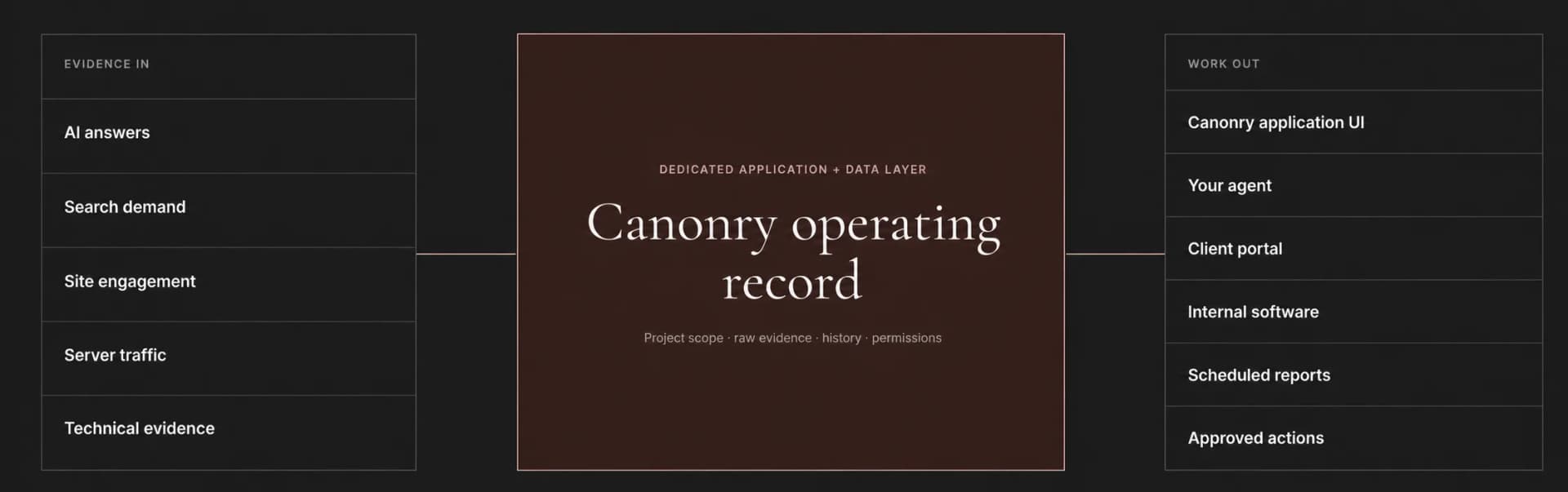
For a multi-market portfolio, that means the question changes from "Did the domain's score move?" to "Which markets changed, which evidence moved with them, and what should the team inspect first?"
A dashboard reports a score. An operating model shows the market, evidence, and next action.
If your organization has one domain with many markets, brands, lines of business, or business units, scope a Canonry Custom deployment. We will start with what must stay separate, which evidence exists today, and how your team needs to use the result.